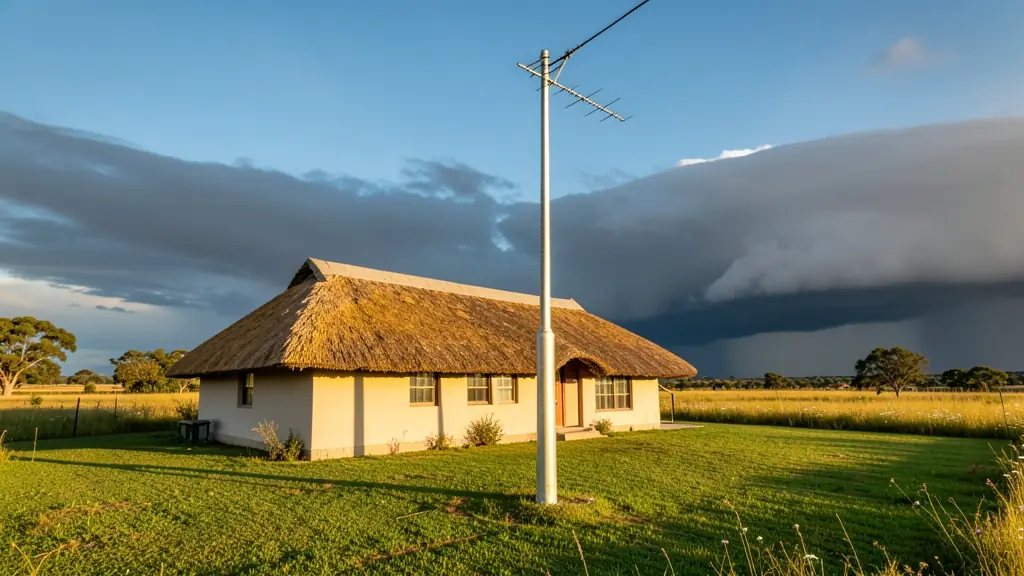
Lightning protection for thatch roofs matters most on the Highveld and in other summer rainfall areas, where storms are frequent and a strike can set dry grass alight in seconds. The usual answer is one or more free-standing masts, set away from the building and earthed, so the strike is caught and taken to ground without touching the thatch, with surge protection for the electrics. Insurers often ask for it. Send one request and we pass it to independent lightning protection installers near you, who quote you directly.
How a free-standing mast works
A mast is a tall pole, set a distance from the thatch and taller than the roof, with an earth system in the ground at its base. It is placed so the roof falls within the area it protects. Conductors should not be fixed on or through the thatch, which is why a mast stands apart. A large or long roof, a house with a separate lapa, or a lodge with many chalets may need more than one. The installer works out the number, height and position, and the system should be installed to the relevant SANS standard. Tall trees beside the house are not protection: a strike on a tree can still jump to the roof or travel through the ground, so do not rely on them.
Earthing and surge protection
A mast is only as good as its earthing. The installer tests the soil and sets earth electrodes to suit. Lightning can also reach the house through power, phone and data lines, so surge protection at the distribution board is usually part of the job. Wiring in the roof itself should be done by a registered electrician who issues a certificate of compliance. Ask whether the quote includes the surge protection and the electrician's work, or only the mast. Unplugging sensitive equipment when a storm comes is still sensible, even with surge protection fitted.
Certificates and your insurer
Many insurers ask whether a thatched building has lightning protection, and some want a certificate from the installer. Ask your insurer exactly what they need before you choose, so the installer can provide it. Estates may have rules on where a mast can stand. A thatch inspection before you buy a house will usually look at the mast too.
Testing an existing mast
Masts lean, earth connections corrode and new buildings go up beside old ones. Many installers suggest a check and an earth test at intervals, and after a strike nearby: ask how often for your system. If you have added a lapa, a carport or a second storey since the mast went in, ask whether the protected area still covers it. While you are planning, look at fire protection as well.
What to put in your request
- How many thatched buildings and how far apart
- Roof sizes and ridge heights, or the plans
- Any mast already in and its age
- What your insurer or estate asks for
- Whether you want surge protection included
Lightning Protection for Thatch Roofs for homes, lodges, farms and venues
- Homeowners: a free-standing mast beside the house and surge protection at the board
- Estate homes and HOAs: masts placed to the estate's rules, with certificates for the HOA and insurers
- Game lodges and bush camps: several masts covering chalets and the main boma, tested regularly
- Guesthouses and B&Bs: the main house and guest rondavels covered before the storm season
- Farms and smallholdings: masts for the farmhouse, lapa and thatched sheds on open land
- Restaurants, pubs and beach bars: a thatched restaurant protected so the insurer will renew the cover
- Resorts and holiday parks: a layout of masts across rows of thatched units, with surge protection
- Wedding venues, schools and churches: a wedding lapa and chapel covered before the summer season
- Builders, architects and developers: the mast and surge protection planned into a new thatch roof from the start
Frequently asked questions
Do you install lightning masts yourselves?
Can I just fix a lightning conductor to the thatch?
What does a lightning conductor cost?
Does my lapa need its own mast?
Lightning Protection for Thatch Roofs by province and city
- Johannesburg
- Pretoria
- Centurion
- Midrand
- Sandton
- Randburg
- Roodepoort
- Krugersdorp
- Randfontein
- Germiston
- Boksburg
- Benoni
- Kempton Park
- Alberton
- Vanderbijlpark
- Vereeniging
- Durban
- Pinetown
- Pietermaritzburg
- Richards Bay
- Newcastle
- Ladysmith
- Gqeberha (Port Elizabeth)
- East London
- Kariega (Uitenhage)
- Mthatha
- Cape Town
- Bellville
- Paarl
- Stellenbosch
- George
- Worcester
- eMalahleni (Witbank)
- Middelburg
- Secunda
- Mbombela (Nelspruit)
- Rustenburg
- Brits
- Klerksdorp
- Potchefstroom
- Mahikeng
- Polokwane
- Tzaneen
- Kimberley
- Upington
- Bloemfontein
- Welkom
- Sasolburg