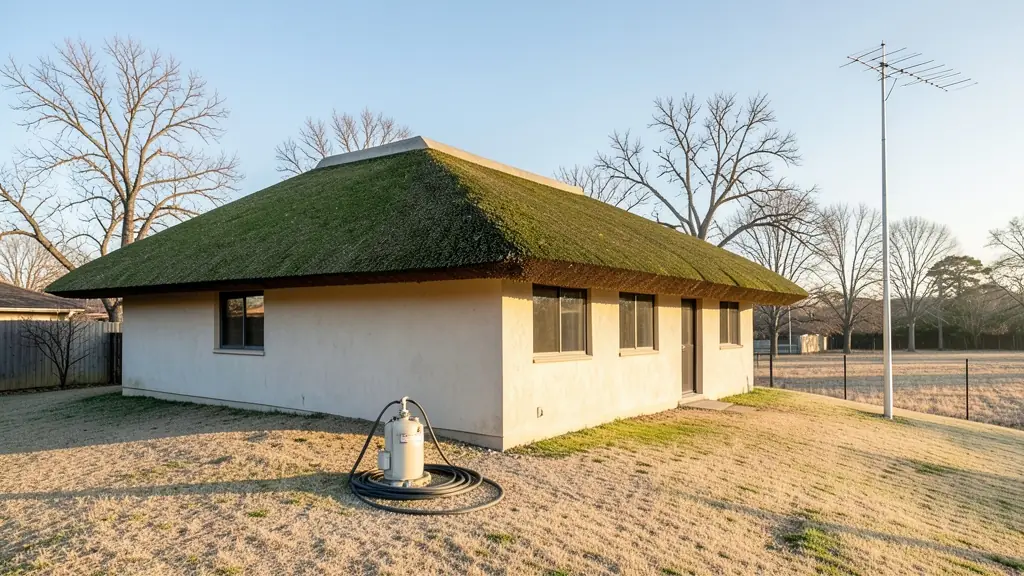
Thatch burns easily, and a thatch fire retardant is one of the simplest ways to slow a fire on the roof. It is a liquid product sprayed or applied onto the thatch that makes the grass harder to ignite and slows the spread of flame. It does not make a roof fireproof, and it wears off with sun and rain. Many insurers and estates ask about it. Tell us about your roof, and we pass your request to independent fire retardant suppliers and applicators who quote you directly.
How it is applied
Most products are sprayed onto dry thatch with a pump sprayer, working down the roof so the liquid soaks into the outer layer of grass. The roof needs to be clean first: moss, leaves and loose grass soak up product and hide thin spots, so cleaning often comes before treatment. Applicators usually work from ladders and roof hooks rather than walking on the thatch. Good weather matters, because rain soon after spraying can wash product off before it has worked in.
Coverage and re-application
The maker gives a coverage rate, usually in litres per square metre, and that depends on the thatch thickness and condition. A quote should say how much product goes on and how many coats. Every product needs re-application at the interval the maker gives, and sooner after heavy weathering, because sun and rain break it down. Write the date of each treatment down and plan the next one. Ask the applicator what the interval is for the product they use.
Certificates and your insurer
After application, ask for a certificate that names the product, the date, the area treated and when it should be redone. Your insurer or estate may ask for it, and a buyer's inspection may look for it too. Ask your insurer what they want before you book, because some ask for a certificate from an applicator rather than a DIY job, and some also want a drencher system or lightning protection.
The look of the roof, and DIY
Some products can darken or slightly change the colour of the grass, and some leave a faint shine at first. Ask to see a roof treated with the same product a year or so ago. DIY is possible on a small lapa or umbrella if you can reach the roof safely and follow the maker's instructions, wear the protection it asks for, and keep it away from ponds, pools and plants. For a house roof, an applicator is usually safer and gives you the certificate. A retardant works best alongside other fire protection.
What to put in your request
- The roof area in m² and the type of building
- When the thatch was last treated, if known
- Whether your insurer or estate needs a certificate
- Whether the roof needs cleaning first
- Access: ladders, height and nearby trees
Thatch Fire Retardant for homes, lodges, farms and venues
- Homeowners: a treated roof and a certificate before the insurer's renewal or a sale
- Estate homes and HOAs: treatment across many homes to meet HOA or insurer requirements
- Game lodges and bush camps: regular treatment of chalets and bomas in veld fire country
- Guesthouses and B&Bs: a treated lapa and cottage roofs near braai areas and guest fires
- Farms and smallholdings: protecting farm lapas and rondavels when winter veld fires run
- Restaurants, pubs and beach bars: treating thatch over seating near grills, heaters and pizza ovens
- Resorts and holiday parks: a rolling treatment plan across rows of thatched units
- Wedding venues, schools and churches: treated thatch halls where candles, heaters and events add risk
- Builders, architects and developers: treatment on a newly thatched roof before handover to the owner
Frequently asked questions
Do you apply fire retardant yourselves?
Does a fire retardant make my thatch fireproof?
How often should thatch be treated?
Can I combine fire retardant with a sealer?
Thatch Fire Retardant by province and city
- Johannesburg
- Pretoria
- Centurion
- Midrand
- Sandton
- Randburg
- Roodepoort
- Krugersdorp
- Randfontein
- Germiston
- Boksburg
- Benoni
- Kempton Park
- Alberton
- Vanderbijlpark
- Vereeniging
- Durban
- Pinetown
- Pietermaritzburg
- Richards Bay
- Newcastle
- Ladysmith
- Gqeberha (Port Elizabeth)
- East London
- Kariega (Uitenhage)
- Mthatha
- Cape Town
- Bellville
- Paarl
- Stellenbosch
- George
- Worcester
- eMalahleni (Witbank)
- Middelburg
- Secunda
- Mbombela (Nelspruit)
- Rustenburg
- Brits
- Klerksdorp
- Potchefstroom
- Mahikeng
- Polokwane
- Tzaneen
- Kimberley
- Upington
- Bloemfontein
- Welkom
- Sasolburg