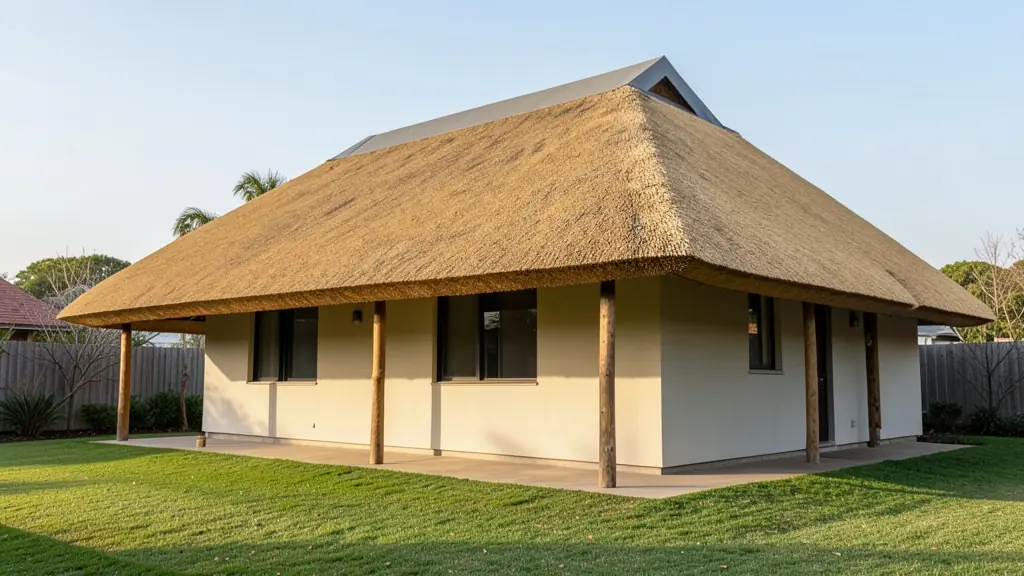
Thatch roofs are still built all over South Africa, on estate homes in Gauteng, lodges in the Lowveld, Cape Dutch farmsteads in the Boland and garden lapas everywhere in between. A good one is steep, thick and sewn tight to a treated pole frame, so rain runs off before it soaks in. This page covers the materials, the frame, pitch and thickness, the ridge, plans and rules, fire and lightning, upkeep, and how thatchers work out a price. Send one request and independent thatchers who work in your area quote you directly.
Grass, Cape reed or synthetic
Most South African thatch is thatching grass, several Hyparrhenia species cut by hand in winter after the grass has seeded and dried, then tied into bundles. Much of it comes from the grasslands of KwaZulu-Natal, Mpumalanga, the Free State and the Eastern Cape. Cape reed, a restio from the southern Cape, gives a finer, denser finish that wears well, and costs more. Synthetic thatch is moulded plastic that looks like grass, does not rot and suits the coast, resorts and beach bars.
Good grass is long, straight, clean and dry, with few leaves or seed heads. See thatch grass for buying it.
The frame, the pitch and the ridge
The thatch sits on treated gum poles used as rafters and purlins, with thin laths fixed across them. The thatch is laid in courses from the eave upwards and sewn to the laths with binding wire or tarred twine, then beaten tight with a leggett.
- Pitch: around 45 degrees is usually the minimum, and steeper roofs shed water faster and last longer.
- Thickness: a finished grass layer is commonly 150 to 200 mm. Ask what thickness is quoted.
- Ridge: a cement or mortar ridge is common here; steel, aluminium, copper or grass ridges are other choices.
Valleys and joins at chimneys and dormers are where leaks usually start.
Plans, fire, lightning and your insurer
The National Building Regulations (SANS 10400, with Part T on fire protection) apply to thatched buildings, including safety distances to boundaries and other buildings, so a new thatch roof usually needs approved plans: check with the municipality, and with the HOA if you live in an estate. SANS 10407 is the code of practice for thatching.
Thatch burns easily. A fire retardant, a drencher system or a fire barrier under the thatch slows a fire; nothing makes thatch fireproof. On the Highveld, a free-standing lightning mast installed to the relevant SANS standard keeps strikes off the roof. Electrical work must be done by a registered electrician with a certificate of compliance. Insurers ask more questions about thatch, so ask yours what they need.
Upkeep and how a quote is built
A well laid roof that dries out between rains often lasts 20 years or more. Shade, humidity and the coast shorten that. Plan a yearly check before the rains, cut back branches, clear valleys, comb and top up thin spots and keep the ridge sound. See thatch roof maintenance and repairs.
Thatchers usually price the thatch per square metre of sloped roof area, materials and labour together or apart, then add the frame, the ridge, scaffolding and travel if the crew comes from far away. Grass is cut in winter and many people want roofs done before the summer rain, so ask early.
What to put in your request
- New roof, re-thatch, repairs or upkeep
- Size and shape of the building
- Roof pitch, if you know it
- Grass, Cape reed or synthetic
- Estate rules, plans and insurer needs
Thatch Roofs for homes, lodges, farms and venues
- Homeowners: a steep thatched roof on the family home, kept sound with a yearly check before the rains
- Estate homes and HOAs: thatched homes built to the estate's architectural guidelines with lightning masts and plans approved
- Game lodges and bush camps: thatched chalets, a main lodge and a boma, re-thatched in rotation between busy seasons
- Guesthouses and B&Bs: thatched rooms and a lapa that need to look neat for guests all year
- Farms and smallholdings: a farmhouse, lapa or workers' houses under grass thatch from nearby grasslands
- Restaurants, pubs and beach bars: a thatched restaurant or beer garden roof with fire protection the insurer accepts
- Resorts and holiday parks: rows of thatched units maintained on a plan, with drenchers and lightning masts
- Wedding venues, schools and churches: a thatched hall or wedding venue with a large roof span and fire precautions
- Builders, architects and developers: a thatcher who works to the plans and the code of practice on a new build
Frequently asked questions
Do you do the thatching yourselves?
How long does a thatch roof last?
Is a thatch roof cool in summer?
Will my insurer cover a thatch roof?
Thatch Roofs by province and city
- Johannesburg
- Pretoria
- Centurion
- Midrand
- Sandton
- Randburg
- Roodepoort
- Krugersdorp
- Randfontein
- Germiston
- Boksburg
- Benoni
- Kempton Park
- Alberton
- Vanderbijlpark
- Vereeniging
- Durban
- Pinetown
- Pietermaritzburg
- Richards Bay
- Newcastle
- Ladysmith
- Gqeberha (Port Elizabeth)
- East London
- Kariega (Uitenhage)
- Mthatha
- Cape Town
- Bellville
- Paarl
- Stellenbosch
- George
- Worcester
- eMalahleni (Witbank)
- Middelburg
- Secunda
- Mbombela (Nelspruit)
- Rustenburg
- Brits
- Klerksdorp
- Potchefstroom
- Mahikeng
- Polokwane
- Tzaneen
- Kimberley
- Upington
- Bloemfontein
- Welkom
- Sasolburg